

Shimegawa – The Sacred Rope Between Worlds
Shimegawa – Meaning, Origins, and the Spiritual Depth of the Sacred Rope in Japan. An Accessible Guide to Culture, Aesthetics, and Craftsmanship
Seiko Begert
12/29/20252 min read
Introduction
In Japanese culture, there are signs that act quietly yet carry immense spiritual depth. Shimegawa belongs to these silent symbols. It is not an everyday object, but a boundary marker—a visible indication that a place, an object, or a moment has been withdrawn from the profane. To encounter a shimegawa is to encounter an ancient concept of purity, mindfulness, and spiritual order that continues to shape Japan to this day.
Shimegawa is closely intertwined with Shintō, Japan’s oldest religious tradition. Yet its meaning extends far beyond religious ritual. It is the expression of a worldview in which nature, craftsmanship, and spirituality form an inseparable unity.
The spiritual meaning of shimegawa
Shimegawa marks a boundary, but not a separating one in the Western sense. Rather, it indicates a transition: from the everyday world into a state of purity. In Shintō belief, kami—divine forces or nature spirits—can only act where purity prevails. Shimegawa makes this state visible.
It is often placed on sacred trees, rocks, shrines, or household altars. It signals that this place is protected and should be treated with respect. This is not about prohibition or isolation, but about awareness. Those who recognize the boundary naturally behave with greater mindfulness.
Notably, shimegawa itself is regularly renewed. The old rope is removed and replaced with a new one. This practice reflects a central aspect of Japanese cultural understanding: purity is not a permanent condition, but a process. Renewal is part of the spiritual order, not its opposite.
Craftsmanship, material, and aesthetic restraint
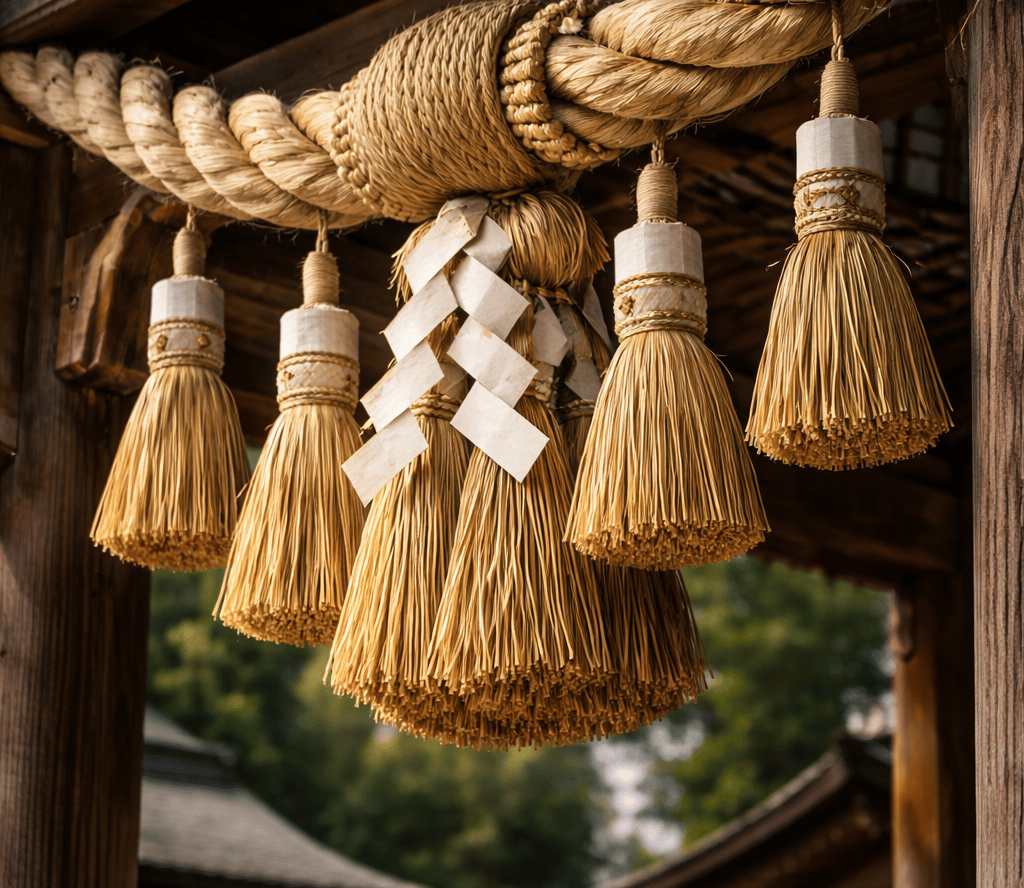
Traditionally, shimegawa is made from rice straw, a material of great symbolic power. For thousands of years, rice has stood in Japan for life, sustenance, and divine blessing. Its production is usually done by hand, in calm and focused work. Every knot and every twist follows inherited forms, without decorative excess.
The aesthetic of shimegawa is deliberately restrained. Its effect arises not from ornamentation, but from presence. White paper strips are often attached, symbolizing purity and spiritual clarity. This combination of natural material and simple form is characteristic of the Japanese understanding of beauty: understated, functional, and sustained by inner meaning.
It is precisely in this simplicity that shimegawa shows its closeness to Japanese craftsmanship as a whole. Whether ceramics, textiles, or woodwork—the idea that materials should be respected and their natural structure allowed to remain visible runs like a common thread through the culture. Shimegawa is not an isolated ritual object, but part of this broader aesthetic attitude.
Shimegawa in contemporary Japan and beyond
Even in modern Japan, shimegawa has lost none of its significance. It can be found not only at major shrines, but also in rural regions, on old trees, or in private spaces. Especially at the turn of the year, it is renewed and symbolizes the transition into a new cycle—free from the burdens of the past.
For many people outside Japan, shimegawa opens a path to a different form of spirituality. It invites a more conscious awareness of boundaries: between everyday life and stillness, between use and respect, between the material and the spiritual. This is not about religious affiliation, but about an attitude of attentiveness.
kasumiyajapan.de embraces these values by presenting Japanese craftsmanship and cultural contexts not as exotic decoration, but as expressions of a deeply rooted philosophy of life. Shimegawa stands as an exemplar of this connection between form, meaning, and inner attitude—quiet, clear, and of timeless relevance.